Strengthen Submarine Cable Resilience
15 July 2026
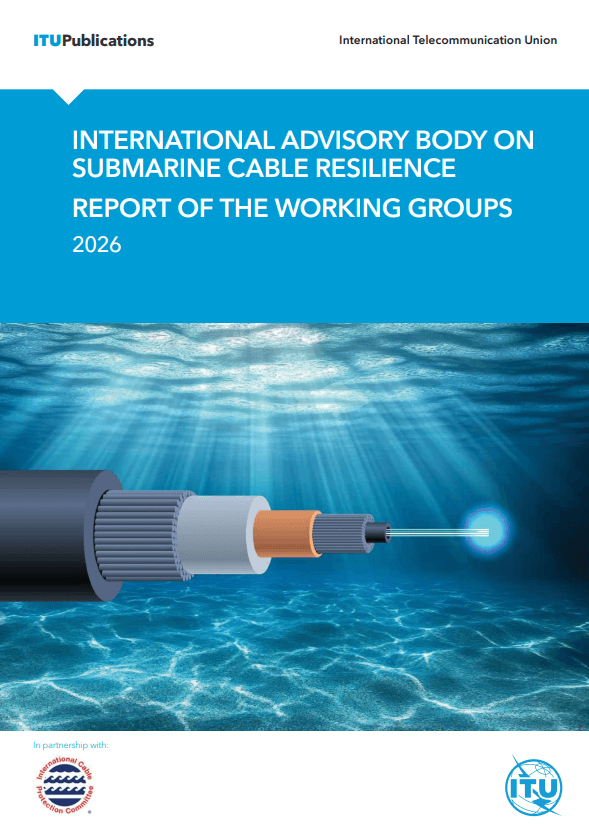
Submarine telecommunication cables are the lifeline of the global digital economy, supporting international communication and finance among other key services. Disruptions to the cables from human activity and natural hazards
can affect essential government and industry operations as well as individual access to education, healthcare and banking.
Key challenges to submarine cable resilience highlighted in the report include high exposure to physical risks, increased time needed for repair, geographical concentration of infrastructure, and high dependence of many countries on a small number of cable systems—particularly small island developing states (SIDS), Least Developed Countries (LDCs) and other underserved regions.
The report further develops Advisory Body recommendations agreed earlier this year across three key areas: timely deployment and repair; risk identification, monitoring and mitigation; and fostering connectivity and geographical diversity.
“The world relies on connectivity, and thanks to the International Advisory Body on Submarine Cable Resilience, we now have a practical roadmap to keep undersea networks reliable.
By bringing together diverse expertise and perspectives from across the submarine cable ecosystem, the report provides a common reference to support international cooperation, inform policy development, and strengthen the resilience of one of the world's most critical digital infrastructure systems.
Jointly developed by governments, international organizations, industry and academia, the report reinforces several priorities for action including:
- strengthening coordination between governments and industry;
- streamlining regulatory and permitting processes;
- improving risk identification and monitoring;
- increasing route diversity and infrastructure redundancy;
- enhancing preparedness and response capabilities;
- addressing the needs of vulnerable regions; and
- integrating climate and environmental considerations.
“What began two years ago as a debate has grown into a global movement," “The Advisory Body and its outcomes show that, when diverse stakeholders come together with a shared purpose, global challenges can be transformed into shared solutions. Our task now is clear: to turn cooperation into lasting resilience for the infrastructure that keeps the world connected. Our legacy will be measured by the resilience the adopted recommendations help build into the world's digital infrastructure for decades to come."
"Submarine cables are the invisible infrastructure that powers our connected world, carrying the vast majority of global data traffic and underpinning everything from digital commerce and financial services to healthcare, education and government operations.
"The recommendations adopted by the International Advisory Body represent an important milestone in strengthening the resilience of this critical infrastructure through greater international cooperation, practical policy guidance, and shared responsibility."
The International Advisory Body on Submarine Cable Resilience was established in 2024 by the International Telecommunication Union (ITU) – the United Nations agency for digital technologies – and the International Cable Protection Committee (ICPC), the leading industry organization promoting submarine cable protection.
The adoption of the reports marks the completion of the Advisory Body's two-year work programmed and leaves a legacy of combining international efforts to strengthen submarine cable resilience, including through summits in Abuja, Nigeria in 2025 and Porto, Portugal earlier this year.
The Advisory Body's final meeting took place on 10 July during ITU's WSIS Forum 2026, part of Geneva Digital Week, alongside the AI for Good Global Summit (7-10 July), and the first UN-mandated Global Dialogue on AI Governance (6-7) July.